






An academic platform for the study of Christian heritage

From the original text to deeper study

Explore the Church Fathers in their original languages, compare translations, and analyze texts with advanced tools — one platform built for researchers and scholars.

  • Advanced search
  • Text comparison
  • Academic analysis
  • Verified sources

The research experience

One platform, every research journey. Four ways into the original text.

An integrated workspace bringing together search across every witness, philological precision, contextual translation, and the connections between texts — built for the serious study of Christian heritage.

λόγος1,284 occurrences
  • John 1:1Alexandria · 4th c.
  • John 1:14Gospel of John
  • Hebrews 4:12To the Hebrews

We Search

Find the passage in its own language, across every witness. One query runs over the whole corpus in Greek, Armenian and Syriac — you look for the word that was written, not for somebody's rendering of it.

λόγος
NounNominativeMasculineGenitive

We Analyze

Open a single word down to its root and its syntax. Every source word becomes structured knowledge — morphology, syntax, roots, grammatical forms, and linguistic context.

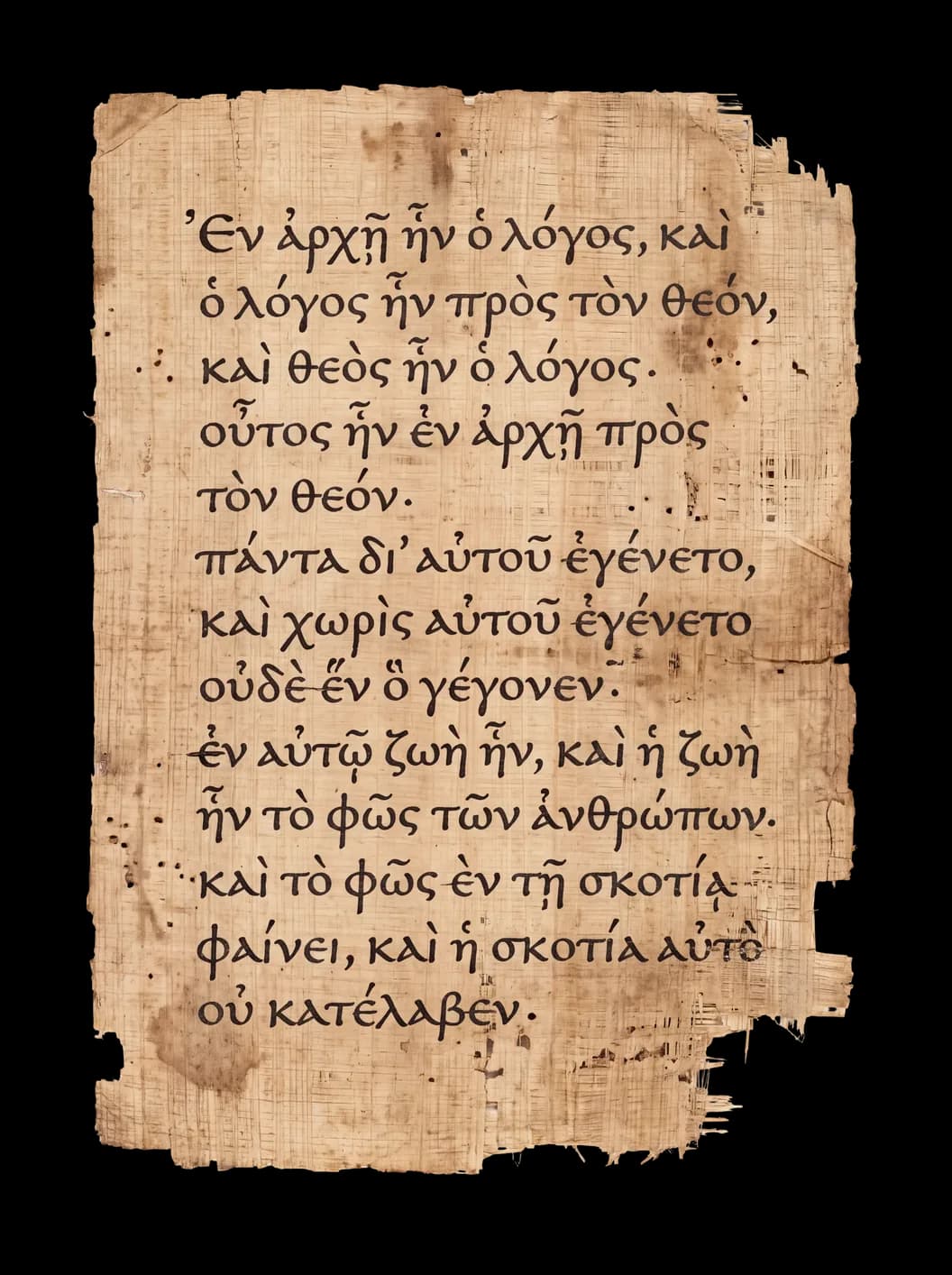
GreekἘν ἀρχῇ ἦν ὁ λόγος
English

InthebeginningwastheWord

We Translate

Greek, English and Arabic — and the reading behind them. Guided by history and ecclesial tradition rather than vocabulary alone — a reading that knows where the text came from.

AugustineChrysostomGregoryBasil

We Connect

See who cites the verse, and where it travels next. Discover citations, shared concepts, and theological relationships across centuries of Christian literature.

Inside the platform

Everything you need, without leaving your research

Search original texts, compare translations, analyze every word, and discover relationships across centuries — all inside one intelligent workspace.

John 1:1Alexandria · 4th century

Ἐν ἀρχῇ ἦν ὁ λόγος, καὶ ὁ λόγος ἦν πρὸς τὸν θεόν.

Morphology

λόγος
Root
λεγ-
Grammar
Noun · 2nd declension
Case
Nominative
Gender
Masculine
Syntax
Subject of ἦν

Translation

GreekἘν ἀρχῇ ἦν ὁ λόγος
EnglishIn the beginning was the Word
Arabicفي البدء كان الكلمة
Theological note

Not “a word” but the pre-existent Word. Chrysostom reads ἀρχή as eternity rather than a point of origin — which is why the article matters.

Citation network

Where this verse travels
λόγοςJohn 1:1EternityAthanasiusChrysostomOn the Incarnation

Research library

A living library of Christian thought

Explore centuries of Christian writing through one interconnected research platform. Original languages, the Church Fathers and the manuscripts, joined in a single research experience.

Logos Patrum

Greek Fathers

  • Athanasius of Alexandria
  • Origen of Alexandria
  • Basil the Great
  • Gregory Nazianzen
  • John Chrysostom
  • Cyril of Alexandria

Latin and Syriac Fathers

  • Augustine of Hippo
  • Ambrose of Milan
  • Jerome of Stridon
  • Tertullian of Carthage
  • Cyprian of Carthage
  • Ephrem the Syrian
  • Aphrahat the Persian Sage

Our features

Everything the platform actually does

Twelve capabilities, built for close reading in the original languages — from instant parsing colour and long-range syntactic arcs to the critical apparatus and reconstruction that states its own confidence.

  • Original sources first

    Every study begins with the original text, preserving linguistic accuracy before interpretation.

  • Context before translation

    Words are presented within their historical, linguistic, and theological context — not in isolation.

  • Transparent AI assistance

    Artificial intelligence assists the research process while keeping the original sources and scholarly evidence visible.

  • Citation-ready by design

    Every passage carries its author, work, edition and section — and exports with all of it still attached.

  • Instant parsing colour

    Every noun, verb and adjective, and every case, in a colour of its own — the structure of a sentence at a single glance.

  • Long-range syntactic arcs

    Curved lines join a verb to its distant subject — the tree of the sentence drawn, not imagined.

  • Relational glow

    Press a subject and its verb lights up at once — Greek grammar learned by working with it rather than by memorising it.

  • Textual criticism tools

    Daggers (†) mark where the manuscripts disagree, and damaged or restored text is labelled as such rather than quietly smoothed over.

  • Lexicon links and rare words

    A mark above each term opens BDAG, LSJ or Lampe, and a badge flags every word that occurs only once — a hapax.

  • Custom rule builder

    Build your own grammatical analysis rule visually and save it — a programmable research environment with no code to write.

  • Reconstruction with a confidence score

    Missing passages are proposed by AI with the confidence stated outright — 94%, say — never as a silent guess.

  • Rhetorical and stylistic analysis

    Parallelism and literary chiasmus found automatically, in matching colours with crossing arrows.

From the research itself

Tools that change how a text is read.

  • I verified a disputed reading in Chrysostom in twenty minutes. The dagger marks and the manuscript apparatus were right there in the text.
    Dr. Helena MarkouProfessor of Patristics · Oriental Studies Faculty
  • My students see Greek grammar glow in front of them. The relational highlight is a teaching tool I could not build in a classroom.
    Fr. Youhanna IbrahimSeminary Lecturer · St. Macarius Theological Seminary
  • The Armenian collection saved manuscripts our library was losing to time. Now they are searchable, and still fully under our control.
    Mariam TadrosManuscript Librarian · Nshan Palanjian Armenian Library

From the knowledge

Ideas that open new doors for research.

Articles and studies that bring you closer to the original texts, help you understand their contexts, and uncover the connections that run across the heritage of the Church.

Against Heresies

Against Heresies

Irenaeus of Lyons · 2nd century AD

On First Principles

On First Principles

Origen of Alexandria · 3rd century AD

On the Incarnation of the Word

On the Incarnation of the Word

Athanasius of Alexandria · 4th century AD

On the Holy Spirit

On the Holy Spirit

Basil the Great · 4th century AD

The Life of Moses

The Life of Moses

Gregory of Nyssa · 4th century AD

Homilies on the Gospel of John

Homilies on the Gospel of John

John Chrysostom · 4th century AD

Browse all articles

Pricing

Choose the plan that matches your research

Begin with a fourteen-day trial. Keep going on the plan that fits how you work.

To try the platform

Free trial

Explore Logos Patrum and the research tools available to you for fourteen days.

Free

14 days free
  • Access to the research tools
  • Word and text analysis
  • AI-assisted translation
  • Comparison of translations
  • Saved searches and notes
  • Access to the available sources and tools
Most chosen

For researchers and translators

Professional

For scholars who work in Logos Patrum every day.

$18/ month

billed monthly

  • Full access to the advanced research tools
  • Advanced translation that reads the context
  • Analysis of the texts and the original languages
  • Comparison of translations and sources
  • Notes and results saved and organised
  • Export of research results and references
  • Priority support from the Logos Patrum team

For institutions and academic teams

Institutional

Flexible arrangements built for universities, institutions and research teams.

Custom

  • Everything in Professional
  • Shared research workspaces
  • User and permission management
  • Usage reporting and analytics
  • Dedicated support for your institution
  • Onboarding and training for the team
  • Arrangements shaped to what your institution needs

Questions

Frequently asked questions

Everything else lives in the documentation.

  • Yes. Every passage carries a translation beside the original, and every word carries its grammar — part of speech, case, root — in plain language. Greek helps; it is not the price of entry.

  • Greek and Armenian in full today, with English and Arabic translation throughout. Syriac, Coptic and Latin are extensions of the same architecture rather than a rebuild.

  • Yes. Any two renderings can be set side by side against the original, with the differences between them marked, so a choice of wording is something you can see rather than take on trust.

  • No. The original is always on screen next to the draft. AI does the mechanical work of a first pass; interpretation, review and the published wording stay with named human scholars.

  • Every passage exports with the metadata the reader shows above it — author, work, edition and section — as BibTeX or as a formatted note. Where a translation has been reviewed for publication, the reviewing scholar is named in the citation rather than left as “the platform”.

  • Yes. Institutional plans are quoted against seat count, private content and access rules. Consortium and multi-campus arrangements are normal rather than exceptional.

  • Continuously. New works are added as they are digitised and reviewed, and every text you already use carries its revision history with it.

Subscribe to our newsletter

Keep up with everything new here — the latest articles and translations reach you as they are added.

One letter a month. We never share your address, and you can unsubscribe at any time.

A papyrus leaf carrying the opening of the Gospel of John in Greek